

Manchester City’s trending moment — and the real tactical story
Manchester City are in the headlines again — this time around a high-profile midfield debate, with noise swirling about a missed deadline, a release clause, and whether a deep-lying metronome was the missing piece. That news-cycle spark matters, but tactically speaking, it points to a larger truth that’s been hiding in plain sight for two seasons: City are doubling down on the vertical eight and the box midfield, not the glamorous regista.
In our view, that choice isn’t just transfer prudence — it’s a structural bet. City believe their chance creation, control, and defensive stability are best served by running power, rotation fluency, and five-lane occupation from a 3-2-2-3 box, rather than a single deep passer orchestrating from the base.
At Manchester City, the deepest midfielder is now a stabiliser and screen — the real creative engine lives one line higher, where vertical eights punch through half-spaces and flip matches with third-man runs.
This is why the latest rumor-cycle matters: it underlines how City see their own evolution. Let’s unpack it — tactically, historically, and with an eye on what it means for the season ahead.
What City’s midfield actually does: the engine is in the half-spaces
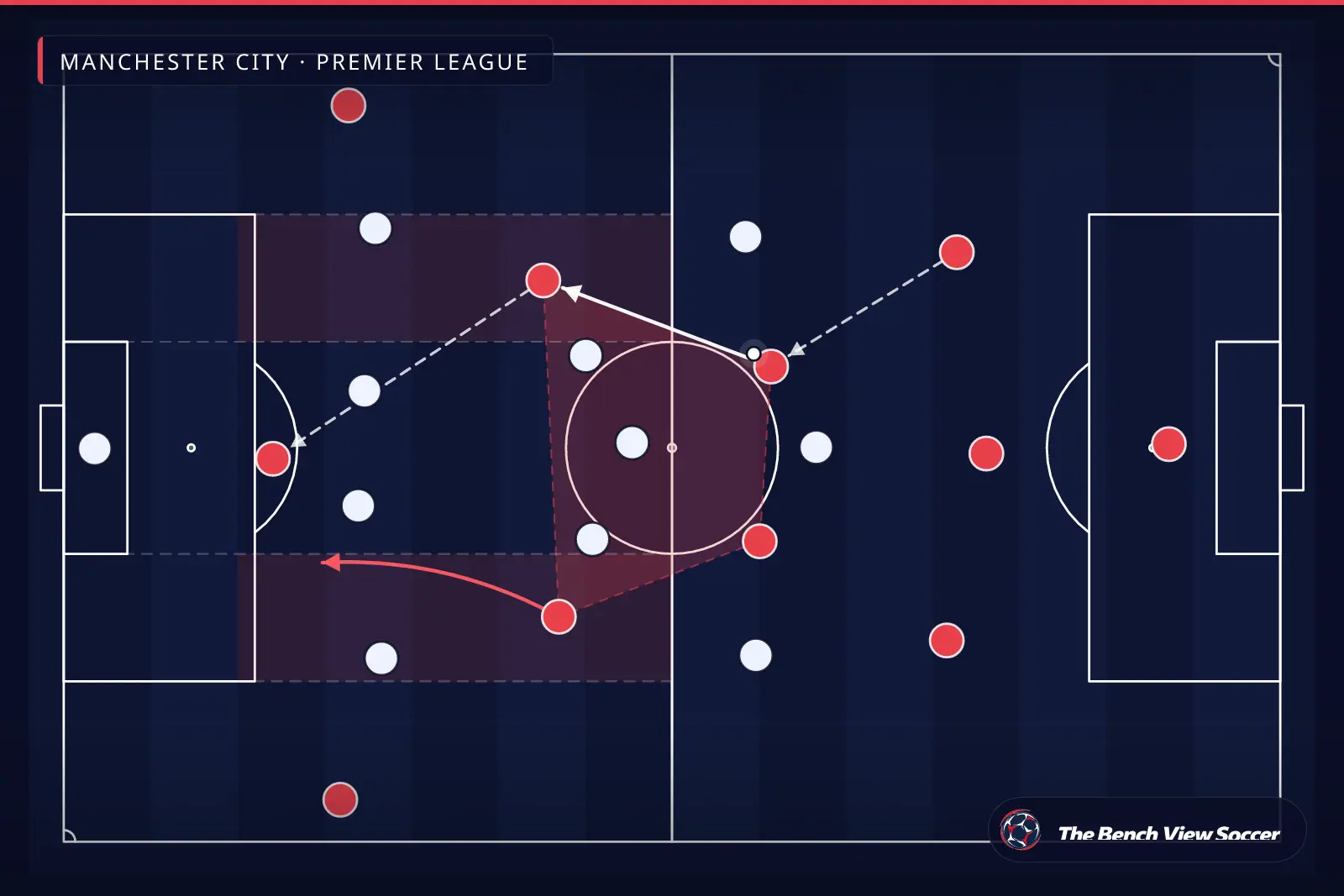
Watch Manchester City in their settled possession for five minutes and you’ll see a choreography that defines the era. Build-up often forms a back three, either with the left-back tucking in and a right-back holding width, or a centre-back stepping out with the ball. Ahead of that sits a double pivot — but functionally, it’s not two equal playmakers. It’s one stabilising pivot next to a hybrid who can step to the ball’s side, and two vertical eights occupying the inside channels in a movable box midfield.
The job of those eights is not to rack up metronomic touches à la traditional regista. It’s to break lines by timing: arriving in the right half-space as the winger pins the full-back; sliding to the left half-space as the nine fixes the centre-backs; trading positions with the winger to create an underlap; or triggering a third-man combination that gets the ball-side eight facing goal in the pocket between lines.
This is why City are so difficult to press. The pass from centre-back to the six is a bait. The real pass is the next one — into an eight on the half-turn or bounced through the nine. Every backward pass to City’s back line can be a pressing trigger for opponents; City reply by tilting the box, lifting an eight, and hitting the vacated space inside the full-back. It is not one deep passer that unlocks this; it is coordinated movement from interiors that keeps the block off-balance.
Build-up architecture: 3-2 security, box superiority, and the third-man
Structurally, City guard against transitions with a 3+2 “net”: three defenders staggered to kill the first wave, two midfielders to collect second balls. The key is that this rest-defense doesn’t just exist when they lose it — it shapes how they attack. With three at the base and two pivots behind the eights, the eights can play ambitious passes, takes, and rotations without leaving the team exposed.
Two repeated mechanisms illustrate the design:
- Third-man bounce: Centre-back to pivot, pivot veers play-side to draw the opposing eight, and a one-touch around the corner releases the interior in stride. The nine either steps short to screen the centre-back or sprints beyond as the decoy for the diagonal.
- Underlap/overlap rotations: Winger holds width to fix the full-back. The ball-side eight starts high, then darts inside the full-back as the full-back or inverted back connects the pass. The far-side eight mirrors the movement, holding a stagger to attack the penalty spot on a cut-back.
Both patterns rely on the eights’ timing and power. They don’t require a deep conductor as much as they demand interiors who can scan, arrive, and carry through contact. That’s the tactical kernel behind City’s apparent lack of urgency for a headline “metronome.”
Chance creation with a target nine: why vertical eights are the feeders
Since adding a penalty-box heavyweight, City’s chance creation has tilted away from constant low crosses after 25-pass sequences to faster lane switches, cut-backs, and inside-lane slips delivered by the interiors. In that design, the eights are the feint — they draw out the holding midfielder, provoke a centre-back to step, and then slide the winger or striker through.
When the right eight receives in the right half-space and shapes to the byline, the weak-side eight lifts toward the D, anticipating the cut-back. The nine pins the near-side centre-back and the far-side winger crushes the back post. The six? He’s not the Hollywood passer; he’s the insurance policy sitting on top of transitions, screening the first counter pass while angling his cover-shadow to discourage the diagonal outlet.
It’s elegant and ruthless. The control doesn’t come from a single deep passer dictating the rhythm. It comes from positional superiority — the eights always having a free shoulder and the back three-plus-pivot always ready to squeeze the next ball.
Why a premium regista is redundant in City’s current model
In a classic 4-3-3 with one six and two eights, the regista is the tempo map. But City’s modern 3-2-2-3 distributes that responsibility laterally and vertically. The deepest “six” may have elite passing, but he is asked to prioritise stability, angles, and body shape over risk. And the second pivot — the one who can step to the ball-side — handles the majority of link play under pressure.
Three reasons a high-fee deep-lying playmaker would be underutilised here:
- Occupation of zones: With the box set, the eights often receive between the lines, not the six. The decisive passes originate one line higher, which compresses the time a deep passer has on the ball and reduces the payoff of his long-range vision.
- Triggers and traps: Opponents press City by jumping on the six, forcing lateral passes. City’s antidote is not longer diagonals from the six; it’s to spin the press with one-touch triangles and find a third-man in the half-space.
- Rest-defense first: The six’s most important role is killing the opponent’s first counter. An aggressive, risk-prone passer there can unbalance the rest-defense. City have repeatedly chosen screeners who shift and sweep, rather than pure quarterbacks.
That’s not an aesthetic choice. It’s the arithmetic of field occupation: five across the front line, a box that bends but doesn’t break, and a back three that dares teams to go long into traps.
Historical context: Guardiola’s evolution from metronome to multi-engine
There was a time when a single deep mind could win Guardiola a season. Think of Barcelona’s golden axis: Busquets as the orientation point, with Xavi and Iniesta ahead — a refined, triangle-based world where the deepest player conducted every press-resistance drill in front of him. At Bayern, the picture blended: Xabi Alonso’s distribution married to Lahm’s inverted mastery and Thiago’s receiving under pressure. The base was still a beacon.
City’s first iteration followed that logic, but gradually diverged. Early City leaned on a more classic double pivot in big matches, even when listed as a single-six system. As the Premier League became more transition-heavy and pressing lines more emboldened, Guardiola’s City built a new normal: a box that turns the six into a safety hub and relocates creativity to the eights and wingers.
The landmark period for this shift was the run that saw City destroy elite presses by moving a centre-back into midfield and letting the interiors run the show. The result: a team that maintains control without sterile possession, compresses the middle third, and wins the first duel after turnovers with frightening consistency. It’s control by occupation and body orientation more than by one distributor’s baton.
Cause and effect: why the market noise makes tactical sense
Strip back the transfer headlines and the tactical logic is clear:
- If your eights create the majority of danger, you invest in eights who can arrive, carry, and slide the final ball under pressure — or in wingers who thrive on being released by those interiors.
- If your six is primarily a screen and an angle-setter, you sign players who are press-resistant in tight spaces, physically robust, and tactically diligent in transition defence — not necessarily the most ambitious passers.
- If your build-up security comes from a 3+2 shape, you value defenders who are comfortable stepping into midfield and wide defenders who can invert to form the two.
When framed this way, the headline “City didn’t meet a midfield deadline” isn’t a sign of indecision but a sign of coherence. They don’t need a deep-lying star to play a part that their structure makes ancillary. They need interiors who can win their lanes, and defenders who let the box breathe.
Pressing and rest-defense: the hidden driver of City’s choice
Pressing systems determine recruitment as much as build-up. City’s press starts in the front three, with the nine shading the centre-back’s passing lane while the ball-side winger jumps to the full-back. Behind them, the eights are the heat. They are the ones who close the half-space release valve, win the first duel, and turn a loose ball into a chance.
That makes the eights’ vertical power a double asset: they attack your box, and they suffocate your out-ball. A sitter with a quarterback’s eye may be elegant in build-up, but if he can’t arrive in the press or shuffle at the tempo City demand, he risks tearing the defensive net. City’s choice prioritises rest-defense integrity and high-field turnovers — the reliable fuel of their chance creation.
How opponents adapted — and City’s counter
Teams have tried to gum the works by denying the eights their pockets. Some flatten their midfield line to man-mark City’s interiors, daring the six to pick them off. Others overprotect the half-spaces, giving up the wing and trusting crosses to be low-probability. The best have staggered presses that leave the first pass open but swarm the second touch.
City’s counter is the patience of a snake. They’ll recycle until your full-back drifts one metre too narrow. They’ll keep the six in the shadows, then in one beat, an interior drops a yard, the winger darts behind, and the far-side eight arrives late to the spot. The pass that mattered came from an eight on the half-turn, not the six on a pedestal.
Where Victor Osimhen fits in the thought experiment
Victor Osimhen’s name floats through any global trend cycle because he changes how teams can attack depth. In City’s structure, a striker with his profile would amplify the same theme: eights as providers, not the six as conductor. Osimhen thrives on early, vertical releases and aggressive penalty-box occupation. In a City context, that would mean:
- Earlier, straighter feeds from an interior when the centre-back steps, with the far-side eight crashing the box to attack the second ball.
- More deliberate use of the inside-left lane for quick double movements: the left eight drags, the winger pins, the nine darts between the centre-backs as the right eight wraps the back post.
- Pressing triggers that start with Osimhen’s first step at the centre-back, cueing an eight to jump the next pass and a winger to lock the touchline.
The point isn’t whether City will or won’t make such a move; it’s that even a striker built for depth doesn’t flip the underlying math. The box midfield remains the platform. The eights remain the timing pieces. The six remains the stabiliser.
Squad-building implications: profiles that matter most
The hybrid centre-back/six
City’s system hums when a centre-back can step into midfield and masquerade as the second pivot. The best version of this player can win aerials, carry through the first line, and switch play cleanly to the weak-side eight. He’s not a regista; he’s a tempo-keeper who protects the rest-defense without demanding an extra touch.
The two-way eight
This is the crown jewel profile. First touch under pressure, shoulder checks every two seconds, and the legs to arrive at both boxes. He must be comfortable in both half-spaces and be able to underlap as naturally as he can hold a high pocket. He also needs the defensive appetite to be the first presser after a loss and the first receiver under heat.
The winger who pins and releases
Opposite the ball-side eight, City value a winger who will relentlessly fix the full-back on the last line. The payoff is not always a dribble; often, it’s the gravity that opens the underlap for the interior. This winger must read the eight’s movement and adjust the width-and-depth relationship intuitively.
The six who screens first, passes second
Comfort evading pressure matters, but in this model, the six’s defensive mechanics are paramount: angle the body to take away the opponent’s No.10, step to smother wall-passes into the striker, and collect clearances with composure. The six can be a good passer — he just doesn’t need to be the orchestra’s soloist.
Comparisons: when a regista did make sense — and why City are different now
Clubs in slower leagues or teams who face mid-blocks with little pressing often benefit from a star deep passer. Think of sides that funnel everything into a quarterback who then drops surgical diagonals to wing runners. But City rarely get that luxury. In the Premier League and late-stage Champions League, opponents press with venom. The deeper your conductor, the harder he gets swarmed.
This is why City shifted the creative hub up a floor. They’ve exchanged the one-baton orchestra for a chamber ensemble of interiors, with the score printed across five lanes. The benefit? More ways to beat the press and more bodies to smother the counter. The cost? You sacrifice some long-range artistry from deep. In City’s calculus, that’s a trade worth making.
A counterargument: could a deep-lying passer raise the ceiling vs low blocks?
There’s a legitimate pushback. Against entrenched low blocks in winter months, when legs are heavy and games compress, a true deep-lying playmaker can unpick the lock with disguised diagonals and rhythm shifts that stun the back line. In matches where the opponent never counters in numbers, the rest-defense premium is reduced and the passing benefits grow.
Additionally, injuries can stress the box’s balance. If the hybrid centre-back who steps into midfield is sidelined, the second pivot can become reactive, forcing the six into more on-ball responsibility. In those windows, a metronome at the base might smooth the possession and keep City from becoming too vertical too quickly.
These are fair concerns, and the best version of City often includes a six who can switch play and break lines when the game asks for it. But even this counterpoint reinforces the central thesis: the role’s primary function in City’s design is still stability and angle-setting. The “ceiling-raiser” work, when needed, is episodic, not systemic.
What it means for the season: training ground to knockout nights
Practically, expect City’s micro-cycles to keep honing a few training-ground staples:
- Two-touch half-space rondos for eights that end with a back-post run pattern.
- Back-three circulation drills with the second pivot stretching to the touchline, inviting a press, then snapping the third-man pass into the interior.
- Rest-defense rehearsals where the six and second pivot take starting positions on either side of the centre circle, calibrated to the opponent’s likely counter lanes.
Against top-six Premier League rivals, City will target the shallow channel between an aggressive full-back and a stepping centre-back — the classic underlap zone for the ball-side eight. In Europe, versus high presses, the first 15 minutes will be about baiting the jump and going around the corner, then pinning the opponent deep and turning the game into a contest of counter-pressing ruthlessness.
In calendar terms, the wear-and-tear period around winter and early spring will test the vertical eights’ durability. City will likely rotate the interiors heavily, not because the role is optional, but because it’s foundational. Fresh legs in those lanes decide titles.
Player pathways: who benefits inside the system
For established City interiors, this is a career accelerator. Players with the blend of first-touch security and straight-line burst — those who can both receive in a phone booth and carry 20 metres — become system-critical. Creative wingers who buy into fixing their marker and timing the blindside dart get an end-product boost. Hybrid defenders who can step up, pass cleanly, and retreat with authority become indispensable.
Even academy prospects can find a pathway if they master the two academy commandments for City interiors: perpetual scanning and body orientation. The rest — the pass flavours and the overlap patterns — are layered on top. But if you can see pressure early and open your hips to either lane, you can live in City’s half-spaces.
What about big-money midfielders from elsewhere?
The moral of this tactical story is not “never sign a star midfielder.” It’s profile alignment. A deep-lying playmaker with the legs to press and the discipline to screen? That can work. But City won’t distort their structure to showcase a quarterback. They’ll buy players who disappear into the system — in the best sense — by making the box sharper, the press more synchronized, and the rest-defense bulletproof.
Case studies that shaped the doctrine
Look back at the elite nights of City’s recent seasons and you’ll see echoes of the doctrine. The interiors don’t just connect play; they decide it. Early in the most dominant performances, City win the half-spaces, then use that access to destroy the weak-side. The base five squeeze the pitch so that even clearances feel like passes to City’s nearest defender. The deepest midfielder’s passing range matters less than his positioning and anticipation. The third-man run does the killing.
The club’s recruitment and development over multiple windows have followed that blueprint. Interchangeable interiors who can handle heat. Wide players coached to the millimetre in when to fix and when to dart. Defenders who are at least bilingual: centre-back and full-back, or full-back and pivot. This has let City outlast different tactical fashions in the league without abandoning their principles.
Zooming back to the trend cycle
So, when the live wires pop about whether City did or didn’t hit a deadline on a deep-lying star, the thoughtful response isn’t to ask if they’re falling behind. It’s to ask whether the profile fits the job description. The evidence says City prefer to put their resources where their marginal gains live: interiors who can turn and run, defenders who can step and screen, and wingers who can pin and release.
Yes, the romance of a regista remains — the 60-yard diagonal, the metronome’s lullaby. But City’s reality is the geometry of the modern superclub: five lanes, a box of four that breathes, and a rest-defense that strangles. The music is written for the eights.
The decisive verdict
Tactically speaking, Manchester City’s latest market posture is not a hedge; it’s a declaration. They are building a future in which the deepest midfielder is a guardian of transitions and angles, and the eights are the protagonists who break games open. That isn’t a rejection of artistry — it’s a reallocation of it, one line higher, where it hurts most.
This is the bet: City will win the season not by buying a new conductor for the base, but by perfecting the choreography of their interiors — the vertical eights who turn five-metre windows into title-winning margins.
And if you’re still scanning the ticker for that regista headline, here’s the line to remember:
At City, the metronome moved upstairs. The box midfield is the stage, the eights are the leads, and the six is the usher who keeps the lights on.
Our verdict: in a world obsessed with marquee deep passers, Manchester City are right to prioritise the roles that decide modern matches — the vertical eights and the movable box that empowers them.
The Bench View app
Don’t just read football — train it
Everything you read here, turned into training you can follow step by step.
Physical training at home
AI daily sessions adapted to your level and position. No equipment needed.
Tactical training courses
Step-by-step courses on positioning, pressing, build-up and decision making.
- 7 days free
- No commitment
- Cancel anytime
Free account: 2 physical sessions + the first tactical course. PRO: 7-day free trial — cancel before day 8 and you pay nothing.
More Analysis
Tottenham Hotspur: How World Cup 2026 Is Warping Their Press
August 27, 2026
Chelsea's 3-2-5 Rest-Defense Is the Real Champions League Edge
August 27, 2026
Aston Villa's Box Midfield Is the Premier League's Real Edge
August 26, 2026
Chelsea's Box Midfield Is Fueling Chaos at the Cottage — Why
August 24, 2026