

Spain’s moment, the noise around it — and the tactical truth
As the global conversation spun around tears at a podium and accusations hurled in a mixed zone, one hard, footballing reality risked getting lost: Spain did not seize World Cup 2026 with rhetoric. They seized it by constructing a relentlessly controllable game-state through a box midfield and an unforgiving rest-defense trap that throttled transitions at source. The emotional aftershocks will fade; the blueprint will not.
In our view, the line from the headlines to the pitch is linear: Spain’s structure left opponents with two choices — rush low-percentage diagonals into a prepared back three, or venture their midfield into a central maze where Spain always had one spare. Either way, Spain owned the next action. The talk will fixate on behavior; the tape will remember distances, angles, and triggers.
Spain didn’t just play with the ball — they engineered the next five seconds after every pass. That, tactically, is the real reason they won the World Cup.
The thesis in one picture: a box, a pin, and a trap
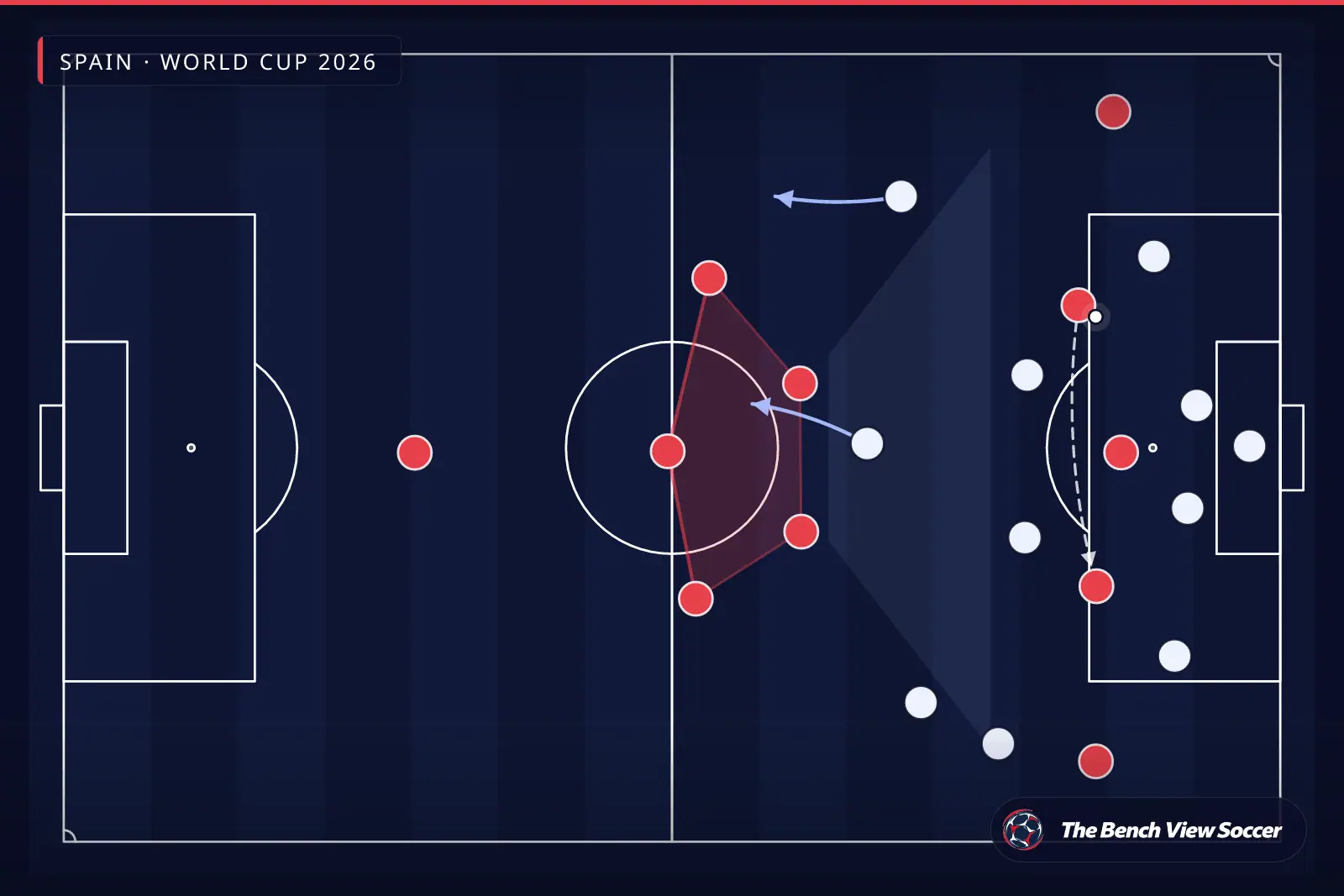
Strip away the jersey badges and see the geometry. Spain built with a 3-2 base — right-back tucking in to form a back three, double pivot ahead — and morphed into a 2-3-5 in sustained possession. The crucial feature wasn’t the front five itself but the interior square: two No. 8s interchanging height with the pivot line to create a box midfield. That box gave positional superiority against almost every pressing scheme seen in this tournament: it cut off cover shadows, generated a free man for a third-man run or bounce, and fixed the opponent’s sixes deeper than they wanted.
On top of that came the rest-defense trap: when Spain lost the ball, the nearest eight and the inverted full-back collapsed diagonally to the ball-carrier’s first outlet while the near-side winger closed the lane to the full-back. The spare center-back stepped across to create a barrier line at the touchline. It looked conservative. It was anything but. The trap didn’t merely stop transitions; it pre-loaded counters from controlled regains.
In tournament football, three sequences decide a tie. Spain trained those three sequences to be the same sequence: regain, release, arrive.
Sequences that defined the final: minutes, lanes, and choices
23rd minute, left half-space: The rehearsal made real
In the 23rd minute, Spain triggered their favorite pattern. The left eight received between lines in the left half-space, tempting pressure from the opposition’s right-sided six. Instead of spinning, he bounced first-time back to the pivot who had already scanned. The right eight sprinted into the opposite half-space as a third-man. One touch, switch. The weak-side winger, who had been hugging the chalk to pin the full-back, delayed his run to stay onside for the cutback channel. Spain didn’t score from the sequence — a near-post toe diverted the cross — but it clarified the hierarchy: Spain decided the where and the when.
38th minute, pressing trigger on a back-pass
When the opponent recycled to their goalkeeper in the 38th minute, Spain tripped their most aggressive pressing trigger. The No. 9 checked short to screen the six, the right winger curved run to block the full-back, and the near eight stepped to jump the center-back’s first touch. The trap aimed not at the ball but at the receiver’s body shape. Forced long, the opponent launched a diagonal into a 2v3. Spain’s spare center-back won the header cleanly, Spain’s right-back secured the second ball inside, and — crucially — the pivot’s starting position in the rest-defense grid turned a 50–50 into a 70–30. Within six seconds, Spain were back in a settled attack, shelling the weak-side lane again.
64th minute, right half-space: The underlap that broke the block
Blocks break not from magic but from masking threats. In the 64th minute, Spain reversed the typical pattern. Instead of an overlapping full-back, the right-back started inside and underlapped into the right half-space as the winger held width. The right eight dropped to cover the interim lane (a micro rest-defense tweak), buying license for the underlap. A wall pass around a stranded six opened the cleanest angle into the penalty spot of the night. The finish glanced wide. The message did not: Spain could change the layer of their attack without surrendering the layer of their security.
What the box really did: five advantages baked in
Against man-oriented mid-blocks — the defensive structure of choice in this World Cup — Spain’s box achieved five repeatable edges:
1) Central overload without isolation: The double interior line meant one eight could post high between lines while the other anchored near the pivot. The defender faced a catch-22: step and leave the striker free between center-backs, or hold and concede the vertical seam. Spain exploited whichever choice appeared.
2) Pre-structure for rest-defense: Starting with two sixes in possession reduced the distance they needed to collapse upon loss, shrinking the opponent’s counter space from 30 meters to 12.
3) Guaranteed third-man route: With a square, Spain always had an angle to bounce around the first presser into the far eight’s blind-side run.
4) Half-space stewardship: Because one interior occupied each half-space, Spain kept the ball away from the touchline traps opponents wanted to spring, while still accessing width via wingers and late, low-risk overlaps.
5) Flexible height control: The box could tilt — at times it became a diamond with one eight dropping to the pivot line to invite pressure, at others a stacked double-10 to push lines back. The opponent never marked like-for-like for long.
Rest-defense: the phase Spain prepared more than anyone
Rest-defense is a misnomer. There is no rest; there is only readiness. Spain’s version functioned on three micro-principles:
- Nearest-five rule: At the moment of the final pass before a potential loss, Spain ensured five players were within a 12-meter radius of the ball. If they lost it, that instantly became a cage.
- Diagonal collapse, never straight: The first recovering run was never vertical; it cut the passing lane to the nearest free man. That denied the opponent the natural out-ball, forcing a riskier carry into Spain’s converging density.
- Back three plus one: With the right-back inverted, Spain often had a spare center-back step wide into duels without fear. Behind him, the far center-back stayed plus-one to defend depth on the weak side.
The visible product was a tournament-high pile of short-lived opponent counters. The hidden product was Spain’s own second-wave attacks built from those regains. When shots did not arrive off the initial build-up, they increasingly arrived off the counterpress — a dynamic that weighs rarer but higher-quality chances.
Why the wing profile mattered: width as pin, not as end
Spain’s wide men were not chalk-on-boots wingers in the old sense; they were magnets pulling full-backs away from half-spaces. The right side held width to stretch the off-ball block horizontally; the left side mixed diagonal receptions with late arrivals on the overlap to manipulate back-post coverage. Crucially, both were drilled in decoy timing: sometimes the most valuable run was the one that never received the ball, the one that kicked the domino in the central lane.
Tactically speaking, this is where Spain’ve diverged from their 2010 ancestors. Back then, width often functioned as patience. In 2026, width functioned as provocation: a way to force the opponent to show their rest-defense and then hit where it bent.
The nine without numbers: how Spain created finishing positions
Spain did not always require a classic penalty-box reference. Instead, they generated finishing positions via occupation rules. The central forward frequently vacated the line to disconnect a center-back from his partner. The far-side eight then ran past the line into the space the striker had created. The next layer: a late-arriving full-back timing his underlap to collect the cutback behind the collapsing block. Call it striker-by-committee. The result was a consistent stream of zone 14 entries and pullbacks with low blockages — chance types that hold up under tournament pressure.
In moments when the match state demanded aerial presence, Spain could switch on a more traditional penalty-box archetype, but even then the system delivered the isolation: back-post overloads with far winger and full-back arriving staggered, the near eight pinning the six to delay the backline’s shift. Everything choreographed, nothing rigid.
Defensive work in open field: from daring to percentage play
There will be a temptation to romanticize Spain’s bravery in transition, but the better word is calculation. The match film shows Spain asking opponents to find line-breaking carries under maximal cognitive load: receive on the back foot, head turned to the sideline, nearest support screened, with a defender approaching on the third step rather than the first. Few attacks survive those constraints.
When teams did escape the first cage, Spain dropped into a narrow 4-4-2 out of possession, one winger folding in to lock the half-space while the other stayed higher as a breakout option. The second wave of pressure came when the ball reached the touchline: backward pass equals trigger, wide body-shape equals squeeze. That detail — pressing the receiver’s angle rather than the ball — underpinned the final’s 38th-minute turnover and several similar sequences across the tournament.
Set plays: the overlooked edge
Spain’s set-piece evolution hasn’t been shouted about, but it might be the clearest sign of a staff comfortable with iteration. Corners blended crowding (three near-post runners to drag the line) with a delayed edge-of-box arrival, usually the inverted full-back or the deeper eight. Short corners acted as reset platforms: re-enter into the half-space and make the opponent repeat a defensive decision under strain. Defensively, Spain stayed zonal at the six-yard line with one spare on the penalty spot to attack second balls. It was risk-managed, not risk-averse.
Historical context: not tiki-taka reborn — tiki-taka re-armed
We have seen Spain control tournaments before. Euro 2008–2012 was a symphony of possession and patience, built on a single pivot era and an almost moral insistence on short passing. What’s different now is Spain’s willingness to move the ball vertically once the advantage appears and their insistence on pre-structuring the turnover phase. If 2010 Spain asked “Can you live without the ball?” then 2026 Spain asked “Can you survive the next five seconds after winning it?”
Comparisons elsewhere are instructive. Germany 2014 had a powerful rest-defense built on counterpressing distances, but their width often came from full-backs alone. France 2018 controlled the game without the ball, mastering space-denial and transition punch. Argentina 2022 balanced genius in the left half-space with a team ethic out of possession. Spain 2026 fused pieces from each: width from wingers, control from interiors, and a rest-defense grid that turned chaos into choreography.
Why this happened: systems thinking, not just selection
The why is cultural and structural as much as it is tactical. La Liga’s last few seasons have incubated a set of profiles — inverted full-backs comfortable stepping into midfield, interiors trained to receive on different footed angles, center-backs drilled in stepping into wide duels — that make a box midfield feel natural rather than forced. The national setup leaned into that reality rather than fighting it.
Training design matters, too. Spain’s sessions, in our view, emphasized constraint-led drills: narrow pitch widths to rehearse diagonal collapses, touch-limit rondos flowing into immediate transitional regains, and scripted third-man patterns that teach scanning before the first pass is played. The proof is how automatic the movements looked under knockout suffocation. You don’t improvise that many optimal decisions by accident.
Cause and effect in the final: match-state mastery
Consider game state as the hidden scoreboard. Spain understood when to raise possession risk and when to shelve it. After taking the lead, the box sank five yards, the wingers’ starting positions dropped a step, and the rest-defense grid tightened. Opponents were forced to accelerate the rhythm of their possessions — just as Spain wanted. It’s counterintuitive: Spain sped the opponent up to slow the game down.
Conversely, chasing an extra goal, Spain cascaded forward on command — but only once their plus-one cover at the back was confirmed. That’s the hallmark of a mature system: the attack’s ambition never outpaces its insurance policy. In the 64th-minute underlap noted earlier, the coverage from the right eight wasn’t a heroic recovery; it was pre-loaded. That is system football.
Positional details the broadcast misses
Half-space depth staggering
The interior duo rarely occupied the same vertical height. When the near eight received between lines, the far eight either mirrored at a different depth to fix the back four, or dropped to receive from the pivot to reverse the triangle. That made pressing traps guesswork for opponents — jump the first pass and the second bypassed you; sit on the second and the first was free.
Body-shape literacy
Spain’s first touches told the story. Interiors opened hips to half-turns when no pressure shadow arrived; when the pressure angle was wrong, they closed body shape to wall passes by design. These micro-decisions produced macro outcomes: they saved half-seconds that multiplied downfield into open shooting windows.
Wing-back timing without wing-backs
Spain effectively got wing-back advantages from full-backs and wingers without committing to a back five. By delaying the full-back’s overlap until the winger’s touch had fixed the full-back, Spain created true 2v1s in the channel — but with their right-back’s default position inverted, the insurance remained in place. It’s a cheat code born of patience: don’t show the run until the defender’s hips are locked.
Opposition adaptation — and why it rarely worked
The best opponents tried three counters. First, a pendulum press: allow the box’s lowest player to receive before snapping two bodies at him, hoping to force a turnover into an unprotected lane. Spain’s answer was the third-man: bounce out, into the far eight. Second, overloading one flank with a winger tucking in as a third midfielder to even the count. Spain simply mirrored the box and trusted their wingers to track without fouling. Third, early diagonals to a weak-side runner. Spain’s spare center-back, empowered by the back-three rest shape, attacked the ball in the air, while the far full-back tucked in to sweep.
None of these solutions consistently broke Spain’s structure because Spain’s principles were portable — they traveled from side to side and from minute to minute. The box was a rule, not a drawing.
Player archetypes that made it hum
It’s tempting to reduce tactics to whiteboard arrows, but profiles are destiny. Spain selected interiors who could carry under contact, pivots with press-resistance and scanning habits, a right-back comfortable as a situational six, and wingers equally fluent attacking the outside shoulder and underlapping into the half-space. The center-backs showed an uncommon blend: one to step early into wide duels, another to sit and sweep depth. This combination allowed Spain to defend forward, yet retreat without panic.
Tactically speaking, the youngest among Spain’s attack offered the acceleration of ideas — brave diagonals, early low crosses through the corridor of uncertainty, timing that launders risk into reward. The veterans supplied game-state intelligence: when to cool the ball, when to force a trigger. That blend is what allows a box midfield to be more than chalk.
What changes against different shapes
Against a 4-4-2, Spain pinned both opposition sixes with the eights and split the center-backs with the nine’s movement. Versus a 4-3-3, the wide winger stayed longer to widen the full-back’s body shape, opening the interior lane for the underlap. Against back fives, Spain resisted the urge to cross early, instead using short combinations to drag a wing-back out of the line before slipping the runner behind. The box never disappeared; its heights and horizontals shifted to maintain the free man.
Psychological control via tactical control
Much will be written about emotions surrounding the final, but match psychology begins with what a structure makes the opponent feel. Spain made opponents feel late. Late to presses, late to second balls, late to rotations. Every time an opponent believed they had a 2v1, Spain’s rest-defense made it a 2v2; every time they felt a 1v1, Spain turned it into a 1v0. That tax on decision-making breaks confidence. In tournament football, belief often travels with the scoreboard; Spain built a plan that made the scoreboard follow the plan.
The macro impact: a template for the next cycle
Looking ahead, the implications are large. International football cycles through imitation: the next wave of contenders will copy one of two things from Spain — the box’s occupation rules or the rest-defense grammar. The smart ones will copy both. Expect to see more right-backs practicing midfield body-shapes, more interiors drilled on blind-side arrivals, and more teams measuring distances at the moment of potential turnover rather than the moment of possession.
For Spain, sustainability depends on reloading the profiles. The template is transferable, but the execution needs pivots who scan under pressure and center-backs happy to defend wide channels. The talent pipeline suggests continuity is plausible. Tactically, the staff’s willingness to tweak the box’s heights opponent by opponent bodes well. This isn’t dogma; it’s a toolkit.
Club-level feedback loop
Expect a feedback loop into La Liga and beyond. Clubs will borrow the national-team box, but with club-time training they’ll likely add more automations — pre-planned rotations on the weak side, even more aggressive full-back underlaps, and occasionally flipping the inversion (left-back stepping in rather than right-back) to suit footedness. Pressing traps cued to back-passes will proliferate; goalkeepers will be tasked with breaking them via clipped diagonals to inside wingers. The arms race begins with angles.
Counterargument: Did the game-state and moments flatter Spain?
A fair counter: tournament football is small-sample chaos disguised as destiny. Spain benefited at times from early goals that made their structure look even more dominant, and opponents missed transitions they usually finish. One could argue that a lower-block-and-break plan, if converted early, would have forced Spain to stretch beyond their comfort, revealing transition gaps. Penalty variance and refereeing rhythms always haunt knockout narratives.
We acknowledge that. But the point of a system is to lower variance. Spain’s box and rest-defense did exactly that. They created matches where the opponent’s pathway to victory required atypical efficiency at low-probability tasks — perfect diagonals under pressure, flawless first touches facing their own corner flag, and clinical finishing from rushed counters. That’s not impossible. It’s just not repeatable.
What it means for Spain’s next steps
Short-term, Spain enter the next international windows as the team to solve, not just the team to beat. Opponents will bring bespoke plans: false full-backs to overload Spain’s rest-defense, double tens pinning Spain’s pivots, and hyper-direct play to bypass the box. Expect Spain to answer with two wrinkles:
1) Occasional double inversion: both full-backs stepping in at once to create a 2-3-5 with a back two, used selectively when opponents camp deep and lack transition speed.
2) Rotating the box’s top line: one eight becomes a second striker for 10-minute spells to bend a back five, then collapses back into midfield before counterpress energy dips.
Medium-term, the staff’s greatest challenge is guarding against the complacency that follows success. The structure is elite, but its edge is in timing, not just positioning. That requires fitness, detail, and constant rehearsal. The good news for Spain: they’ve already shown an appetite for micro-evolution. The box in July may not be the box in October — and that’s strength, not drift.
The learning for everyone else
For coaches and players watching, the lesson isn’t “play a box.” It’s “pre-structure the next action.” Spain’s genius this summer was not a shape; it was the insistence that every attacking choice also be a defensive choice. You could see it in body shapes, in rest distances, in the way five nearest players closed instantly on loss, and in the trust that the far-side full-back would always be in the lane when the diagonal came. That is modern international football at its most teachable.
The final word
The surrounding narratives will have their week. They always do. But when the clips loop in coaching courses and academy classrooms, the moment they freeze won’t be a press conference. It will be a 23rd-minute bounce pass in the left half-space, a 38th-minute pressing trigger on a back-pass, and a 64th-minute underlap switching the layer of attack without loosening the layer of security. That’s where Spain’s World Cup lived — in distances and decisions.
Tactically speaking, that is the quotient that outlasts the headlines. Spain didn’t escape the tournament with brilliance in the margins; they redrew the center of the page.
And that’s the shareable truth: Spain didn’t just win a World Cup. They taught one.
The Bench View app
Don’t just read football — train it
Everything you read here, turned into training you can follow step by step.
Physical training at home
AI daily sessions adapted to your level and position. No equipment needed.
Tactical training courses
Step-by-step courses on positioning, pressing, build-up and decision making.
- 7 days free
- No commitment
- Cancel anytime
Free account: 2 physical sessions + the first tactical course. PRO: 7-day free trial — cancel before day 8 and you pay nothing.

More Analysis
Tottenham Hotspur: How World Cup 2026 Is Warping Their Press
August 27, 2026
Chelsea's 3-2-5 Rest-Defense Is the Real Champions League Edge
August 27, 2026
Aston Villa's Box Midfield Is the Premier League's Real Edge
August 26, 2026
Chelsea's Box Midfield Is Fueling Chaos at the Cottage — Why
August 24, 2026